Showing posts with label Europe. Show all posts

Thursday, December 20, 2012

Brussels Tram (Video Clip)

The Brussels tram (or streetcar) system is a successful medium-sized system, whose development demonstrates many of the quandaries that face local public transport planners. It also has a number of interesting peculiarities.

There are 17 routes, serving most points of the compass, and including two partial ring routes. These have a very varied feel, including street running through narrow streets in working class districts (lines 81 and 82), cobbled central reservation, reserved track through parkland and woods (44), and signal-controlled running in tunnels (the "premetro"). There are even some short stretches of gutter running (18). Almost all trams are double-ended and all are double-sided, and some stub termini in the middle of the road remain (55), although most have loops. The route pattern shows some notable gaps, particularly along major radial routes, because these were originally served by a separate tram system, the national network of tramways vicinaux/buurtspoorwegen. These had a track gauge of one metre, as against the Brussels standard gauge, and so the tracks could not easily be taken over when the lines were progressively closed from the 1960s onwards.
The complementary routing of vicinal and urban tracks and the replacement of key lines by metro has led to some peculiar track layouts, for instance at the Barrière de St-Gilles/Bareel St-Gillis. Of the seven roads that meet at this circular junction, six originally contained tramlines, whereas today only three do. To negotiate a sharp turn, route 18, until it was closed on 1 July 2007, had to make a 270-degree turn on its journey away from the city centre, looping round and crossing its own path.
A further peculiarity is that under the South station, the premetro and metro tracks both swap from running on the right to running on the left where they run parallel to provide cross-platform interchange between the two lines. This serves no apparent purpose, but may be because main line trains in Belgium run on the left. The metro returns to running on the right under the new Jacques Brel depot.
Between 2006 and 2009 a phased transformation of the tram network took place, with the aim of improving regularity and relieving overcrowding. As part of this the premetro service between North station and Albert was restructured with fewer lines passing through it, but at more regular intervals. These routes use the new longer Bombardier trams. During this period of transformation the bus network underwent complementary revisions.

The Brussels Tram System


Intermodal integration

The system exists in an interesting local government context, because Brussels is a self-governing region, in fact an enclave within Flanders, although lying only some 3.3 kilometres from Wallonia at the closest point. This means that three-way deals are necessary between Brussels’ own STIB/MIVB, Flanders’ De Lijn and Wallonia’s TEC. Within the range of transport modes operated by STIB/MIVB (the Brussels Intercommunal Transport Company) trams fall between buses and a heavy metro. But beyond that, STIB sees itself as a provider of mobility rather than just public transport, and has a 49% share in the town’s Cambio car sharing franchise. 

The Brussels conurbation – its 19 municipalities plus adjoining commuter belt – is also served by a fairly dense network of main-line trains. There is a good level of interticketing, and multiple-journey cards are interchangeable. A simple tariff system permits passengers to make unlimited changes with a one-hour period at a cost of €2.50 when bought from the driver or €2.00 when bought from a ticket machine.
Ridership has been rising, and other user-friendly features that have grown up through custom and practice help this. For instance passengers open the doors themselves by pressing a green strip on the central pole, and drivers usually make a point of waiting for latecomers. However overcrowding at rush hours and at weekend is common, and fare-dodging is reputedly quite high, despite periodic enforcement campaigns.


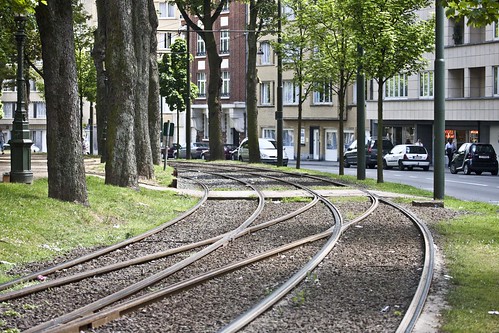
Brussels - Tram system (Route 19)

Brussels - Tram system by infomatique
Brussels - Tram system, a photo by infomatique on Flickr.
The tram route 19 in Brussels, Belgium is a tram route operated by the STIB/MIVB, which connects the Flemish town of Groot-Bijgaarden in the municipality of Dilbeek to the De Wand stop in Laeken in the municipality of the City of Brussels.

Starting from the Groot-Bijgaarden railway station in Dilbeek, the route then stops at the Bayens roundabout and then enters the Brussels-Capital Region via the Brusselstraat. The first stop in Brussels is at Hunderenveld in the municipality of Sint-Agatha-Berchem. The route then runs along the Avenue du Roi Albert/Koning Albertlaan up to the Dr. Schweitzer square, the Avenue Josse Goffin/Josse Goffinlaan and the Avenue de l'Hôpital Français/Frans Gasthuislaan where it enters the municipality of Koekelberg. The route then runs along the Basilica of the Sacred Heart and the Elisabeth park on the Avenue du Panthéon/Pantheonlaan and then on the Avenue de la Liberté/Vrijheidslaan up to the Simonis metro station. At Simonis the route turns left on the Avenue de Jette/Jetselaan and then enters the municipality of Jette. At the Queen Astrid square the route heads towards the Jette railway station via the Rue Léon Théodor/Léon Théodorstraat, then runs around the Jette cemetary via the Rue Jules Lahaye/Jules Lahayestraat and enters the Boulevard de Smet de Naeyer/De Smet de Naeyerlaan. Further on this boulevard, the route enters the borough of Laeken in the City of Brussels and then connects again with the Brussels Metro at the Stuyvenbergh metro station. The route finally runs along the Avenue des Robiniers/Witte Acacialaan and Avenue Jean Sobieski/Jan Sobieskilaan and then crosses the Laeken park by entering a tunnel which ends at the other end of the Laeken park at the De Wand stop.

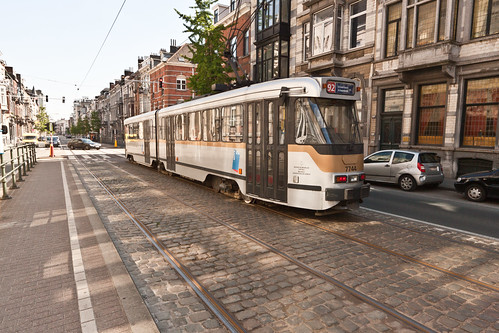
No. 92 Tram - Brussels

No. 92 Tram - Brussels by infomatique
No. 92 Tram - Brussels, a photo by infomatique on Flickr.
There are 17 routes, serving most points of the compass, and including two partial ring routes. These have a very varied feel, including street running through narrow streets in working class districts (lines 81 and 82), cobbled central reservation, reserved track through parkland and woods (44), and signal-controlled running in tunnels (the "premetro"). There are even some short stretches of gutter running (18). Almost all trams are double-ended and all are double-sided, and some stub termini remain (4, 55), although most have loops. The route pattern shows some notable gaps, particularly along major radial routes, because these were originally served by a separate tram system, the national network of buurtspoorwegen/tramways vicinaux. These had a track gauge of one metre, as against the Brussels standard gauge, and so the tracks could not easily be taken over when the lines were progressively closed from the 1960s onwards.

The complementary routing of vicinal and urban tracks and the replacement of key lines by metro has led to some peculiar track layouts, for instance at the Barrière de St-Gilles/Bareel St-Gillis. Of the seven roads that meet at this circular junction, all originally contained tramlines, whereas today only three do. To negotiate a sharp turn, route 18, until it was closed on 1 July 2007, had to make a 270-degree turn on its journey away from the city centre, looping round and crossing its own path.

A further peculiarity is that under the South station, the premetro and metro tracks both swap from running on the right to running on the left where they run parallel to provide cross-platform interchange between the two lines. This serves no apparent purpose, but may be because main line trains in Belgium run on the left. The metro returns to running on the right under the new Jacques Brel depot.

Between 2006 and 2009 a phased transformation of the tram network took place, with the aim of improving regularity and relieving overcrowding. As part of this the premetro service between North station and Albert was restructured with fewer lines passing through it, but at more regular intervals. These routes use the new longer Bombardier trams. The major part of the North-South Axis (from Lemonnier to Rogier) is now only used by lines 3 and 4 during the day. Tram lines 55 and 56 from Schaerbeek (north of Brussels) that used to ride the North-South Axis now stop at Rogier and nearby Gare du Nord/Noordstation.

As part of that plan, line 52 has been replaced by line 3 in the North (from the Brussels-South railway station to Thomas and from Van Praet to Esplanade), and by lines 56 (from Rogier to Princess Elisabeth), 82 (from Drogenbos to Lemonnier) and 32 in the South.

An already implemented part of this plan is the creation of tramway lines 24 and 25. Since April 2007 the new line 25 goes from Rogier to the Boondael/Boondaal railway station following the route of the ex-line 90 from Rogier to Buyl, then leaves the outer ring towards the Université Libre de Bruxelles campus of Solbosch. The (somewhat older) new line 24 strengthens the tram presence on the outer ring during daytime; it goes from the Schaerbeek/Schaarbeek railway station to Vanderkindere in Uccle.

en.wikipedia.org/wiki/Brussels_trams

Trams in Brussels

The Brussels Tram (or streetcar) system is one of the ten largest in the world, carrying some 75.6 million passengers in 2009. Its development demonstrates many of the quandaries that face local public transport planners. It also has a number of interesting peculiarities.

LUSA TRAM SYSTEM - LAUNCH OF SERVICE WAS DELAYED


The original launch date for the Luas was to be 2003, but delays in construction saw this date pushed back by a year.

An advertising campaign took place to inform the public of the development of the system, while construction was taking place. Construction finished in February 2004 and a period of testing and driver training began. 30 June 2004 was decided on as the official launch date of the Green Line.

The first tram went into service for the general public at 3 p.m. Several days of free ridership and a family fun weekend took place to launch the system. The Red Line opened on 26 September 2004, with six days of free travel for the general public.

Wednesday, December 19, 2012

Belgium: Trams in Ghent


The Ghent tramway network is part of the public transport system in the city of Ghent, Belgium, with a total of three lines (1, 21/22 and 4). Since 1991, it has been operated by De Lijn, the public transport entity responsible for buses and trams in Flanders.

As of the end of 2008, there were 40 HermeLijn trams and 43 PCC trams, running on three routes.


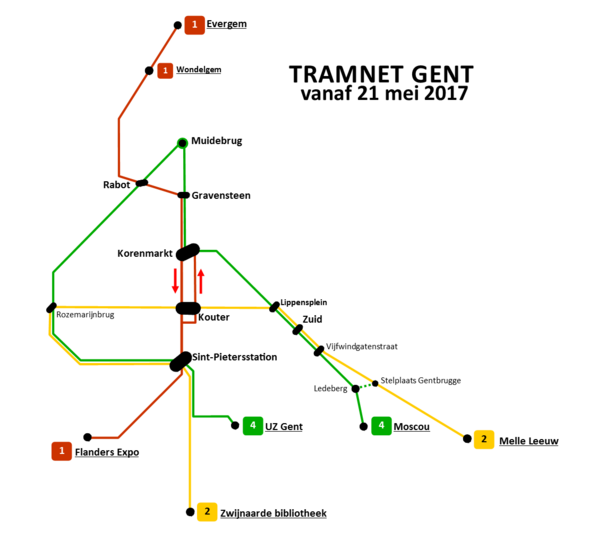
Belgium: Trams in Ghent - Route Map
Photograph By: Maksim

General description


The network covers approximately 30 kilometers. The rail gauge is 1000 mm and trams are powered by 600V DC overhead wires. The network uses dedicated rights of way as well as mixed traffic; the right of way on Groot-Britanniëlaan is shared with by buses.
The system used to have one short tunnel, around 150 meters long, passing underneath Sint-Pieters railway station.The Sint-Pieters Station tram stop was located inside the tunnel. It was opened on June 28, 1996.

The system has no triangles and only a single turnback loop. Therefore, all rolling-stock must be bidirectional, with cabs at each end. There are also two non-switch 90-degree crossings, between the lines of routes 1 and 21/22, on the crossing of Zonnestraat with Veldstraat as well as Korte Meers street. There are two crossings because the track of route 1 passes over streets in each direction. Along the Korte Meer the tram track goes toward the city center, the Korenmarkt stop, yet returns along the pedestrian/tram-only shopping area along the Veldstraat.

On streets where tram tracks are located away from the sidewalk, i.e. in the middle of the roadway, stops are located on islands with pedestrian overpasses leading to them. This improves pedestrian safety.

Austria: Trams

In Austria, Gmunden, Graz, Innsbruck, Linz and Vienna all have tramway systems. With 173.4 km of track, Vienna's network is one of the largest in the world. 

The cars have been constantly modernised over the years and many are now ultra low-floored. Many of the Austrian tramlines have been in constant operation since they were first opened. Vienna started with horse trams in 1865 with electrification in 1897. Graz had horse trams in 1878 and electric cars in 1898 while Linz goes back to 1880 with electrification in 1897.


The Gmunden Tramway, only 2.3 km long, is currently one of the shortest in the world. With gradients of up to 9.6%,  it is also one of the steepest and has become a popular tourist attraction.


Innsbruck, which traditionally used second-hand trams from other cities, has recently replaced its whole fleet with 32 Bombardier low-floor cars (as of Summer 2009). The Pöstlingbergbahn, in Linz, is an unusual "mountain tramway", which has a gradient of 10.6% [one of the world's steepest gradients on a surviving adhesion-only railway] and now reaches the city centre via the tracks of the urban tram system.

Trams in Europe


Europe has an extensive number of tramway networks. Some of these networks have been upgraded to light rail standards, called Stadtbahn in Germany, premetros in Belgium, sneltram in the Netherlands, and fast trams in some other countries.

Overview

Tramline crossing the Manchester Ship Canal,ManchesterEngland.


All the former communist countries of Central and Eastern Europe, excluding Lithuania, the Republic of Macedonia, Montenegro, Moldova and Slovenia, have extensive tram infrastructure. Industrial freight use of city tram lines was a widespread practice until 1960s but has since mostly disappeared. Another factor is an increasing replacement of trams with trolleybuses as cities face a rapid increase in traffic and such replacement often allows to increase road size. One of the exceptions is Warsaw, Poland, where the last trolleybus line was closed in the year 1995 due to high maintenance costs, and replaced with buses. Czech ČKD Tatra and the Hungarian Ganz factories were notable manufacturers of trams.

In recent decades, tram networks in countries including France, Germany, Spain and Portugal have grown considerably. The Netherlands, which already makes extensive use of trams, has plans to expand trams to two additional cities.
Germany did not undergo the tramway closure programmes that were carried out in other European countries and many cities retain their original tram networks. In some places, tram networks have been added or expanded through the introduction of hybrid tram-train or stadtbahn systems which may combine standard railway, on-street and underground operations. Notable examples include the systems in Cologneand Karlsruhe. In Frankfurt-am-Main, many tram lines were transferred to U-Bahn operation.
In the United Kingdom, investment in public transport in the late 1980s turned to light rail as an alternative to more costly underground railway solutions, with the opening of the Tyne and Wear Metro (1980) and the Docklands Light Railway in London (1987) systems. However, the first British city to reintroduce on-street tram-style rail services was Manchester, with the opening of its Metrolink network in 1992. Many other UK cities followed with their own tram-style light rail systems, including Sheffield (Supertram, opened 1994), Birmingham and Wolverhampton (Midland Metro, opened 1999), London (Tramlink, opened 2000) and Nottingham (Nottingham Express Transit, opened 2004). Many of these new systems are planning network extensions and several new tram systems are being proposed or are under construction, such as Edinburgh Trams, Belfast EWAY (proposed) and Liverpool Merseytram (proposed). Other tramway projects have not made it beyond the proposal stage because of funding problems, for example London's Cross River Tram and the Leeds Supertram.
Paris reintroduced trams with line T1 in 1992, and many French cities have seen a similar revival,for example the Tramway de Grenoble and the Montpellier trams.
The Czech capital Prague plans one new line and the extension of eight others between 2007 and 2016, with an official of the Prague Public Transport Company stating that "In Europe in the past 10 years, tram transportation is the preferred way of transit; we can say that tram transportation is going through its renaissance period".